Oliver Hollander – Grandson
A day hasn’t gone by since Grandpa’s death that I haven’t thought of him, even whilst I’ve been kept busy here in China. And, as if by magic, now when I recall him it isn’t cooped up in a nursing home and unable to talk all that much. It’s his old self that I remember, the smiling, chatty, warm, simultaneously silly and serious man that we all knew and loved.
I tend to distrust nostalgia, because it has a romanticizing effect that can distort reality. But, this is the truth: when I look back on all of my time with Grandpa, I can’t remember a single bad memory. Not a single one. There are few people you can honestly say that about. He was special.
Which is not to say he didn’t have flaws. He did, of course. It’s just that he was so amusing and self-deprecating about them that we came to love them just as well as we did, say, his humour and intelligence and intellectual curiosity. Us grandchildren were particularly amused with his flaws, which made him seem more childlike and hence a great playmate for us: as youngsters we wrote a list called ‘Grandpa’s Mistakes’, which we added to daily whilst staying with him, and included, from my memory, mistaking dog poo for a hedgehog and managing to drop ice cream all over his shirt. His absolutely terrible grasp of modern technology in particular provided much amusement for us over the years – remembering him fumbling around with the TV remote for minutes on end still makes me laugh out loud all these years later.
But as I got older I started to appreciate him more for his positive attributes rather than his clumsiness. His passion for certain things in life was infectious, and rubbed off on others very easily. For me, it was his interest in film that sparked a lifelong passion. I remember him introducing me to an old black and white film called The 39 Stepswhen I was about 7 years old. It sounded boring. Except it wasn’t: it was funny and intriguing and exciting and magical. And watching it with him, roaring with laughter and shaking my arm in tense moments in anticipation, made it doubly so. In that moment I became hooked on classic films for life, and Hitchcock is still my favourite filmmaker. I have enormous gratitude to Grandpa for that.
But more important as an influence was his general attitude to life. He took all the right things seriously: politics, education, work, friends and family. But he could laugh at just about everything else. And because of that we always loved spending time with him. I mimicked his jokes with classmates at school and have consciously tried to emulate his positivity at many times in my life.
We all have to die, but if someone’s lived their life right they’ll live on in the memory and actions of other people. In that way, Grandpa will live on in us for as long as any of us shall live.
Matthew Reisz, Times Higher Education
A historian who transformed our understanding of earlymodern England has died.
William Lamont was born in London in 1934 and educated at Harrow Weald County Grammar School. It was only at the last moment that he decided to apply to university and secured a place to study history at what was then Queen Mary College (1952-55), now Queen Mary University of London. He trained to be a teacher: at the Institute of Education (1955-56), now parr ofUCL, and taught part-time at St Paul’s School (1955-59) while pursuing a doctorate at the Institute of Historical Research (I956-61), part of the University of London, on the 17th-century lawyer and polemicist William Prynne. This layer became his first book, Marginal Prynne, 1600-1669 (1963).
After teaching at Hackney Downs School (1959-53),Professor Lamont was appointed lecturer in history at the Aberdeen College of Education (1963-66),
University of Aberdeen. From there, he moved to the University of Sussex for the rest of his career (1966-99), as a professor from 1980. He fully embraced the new university’s commitment to interdisciplinarity, for example in a joint course with Sybil Oldfield that led to their co-edited book Politics, Religion, and Literature in the Seuenteenth Century (1975). He published a series of path-breakingbooks on the same era, including Godly Rule: politics and
Religion, 1603-1660 (1969), puritanism and Historical Controversy (1996) and, after retirement, Last Witnesses:the Muggletonian History, l652-1979 (2006). He also appeared on a television programme with the widow of the last known Muggletonian, a surprising survivor of a sect that had been highly obscure even in the 17th century.
In a collection titled Willie Lamont: History Man, published by his widow Linda Lamont in 2016, ColinDavis, emeritus professor of history at the University of East Anglia, described how he had exploded the simple view of Puritans as “clear-headed, single-minded [and]certain in their righteousness” and revealed puritan politics as “complex, sometimes stumbling and confused, full of dilemmas and pitfalls for the conscientious. Simple, black and white, certainties were gone…This, for me, is that major transformation which the scholarship ofW7illie, and others, wrought, deepening and enhancing our understanding of early modern history and the English Revolution.”
Few other “intellectual heavyweights”, professor Davis went on, “bear that title so lightly and inspire so much affection amongst colleagues, students and ancillary staff. Working with Willie, once it was known that that was what you were doing, was like being given a bus pass into the (in my case, undeserved) affections of others.”
Professor Lamont died on 31 December and is survivedby Linda, their three daughters and nine grandchildren.
Colin Davis, The Guardian
My friend and colleague William Lamont, who has died aged 84, was an inspiring historian, a visionary teacher and a wonderful human being.
Born in Harrow, Middlesex (now in the London borough of Harrow), Willie was the eldest child of a Hebridean, Hector Lamont, and his wife, Hughina (née MacFadyen). Hector had been a purser on the MacBrayne ferries serving Scotland’s west coast, but the couple had moved to London, where he became a bank clerk.
Willie attended Priestmead primary school (interrupted by evacuation to Oban in 1941) and then Harrow Weald grammar school. After graduating with a degree in history from Queen Mary College, University of London (now Queen Mary University of London), he combined school teaching with doctoral research at the Institute of Historical Research.
His thesis topic was the unattractive and combative, but important William Prynne (1600-69), a Puritan lawyer and polemicist. William discovered that the received image of early modern Puritans as cloaking their secular interests in religious language would not do. An unbeliever himself, he insisted that their faith, what they said and wrote, should be taken seriously, however eccentric to modern eyes, a theme expounded in perhaps his best- known work, Godly Rule (1969).
In studies of Richard Baxter (1979) and the remarkable sect of the Muggletonians (2006), as well as numerous essays and reviews, William further developed these insights into Puritan ideologues – and illustrated the sophisticated Biblicism and subtlety of thought underpinning their ideas.
His work led to re-evaluations of what Puritans and Puritanism had been held, in part at least, to be responsible for: the English revolution, the rise of capitalism and the middle class, parliamentary government, the scientific revolution and, eventually, the rise of secular individualism.
In 1966, after a lectureship in history at the Aberdeen College of Education, he was appointed to a lectureship in the School of Educational Studies at the newly founded University of Sussex. He was to remain there for the rest of his career, from 1970 as reader and from 1980 as professor.
Sussex was one of the most successful of the Robbins universities established as the British university system expanded in the late 20th century – and William was one of its great practitioners, committed to teaching and research across disciplinary boundaries.
An enemy of bureaucracy in higher education, he was also an energetic proponent of keeping the academy’s doors open to all-comers, what today would be called “outreach”.
Many who knew him will fondly recall his gift for friendship: ever ready with a fund of stories.
Devoted to Arsenal FC, the Labour party and, above all, his family, he is survived by his wife of almost 58 years, Linda (nee Murphy), three daughters, Catriona, Ailsa and Tara, and nine grandchildren.
John Morrill, History Today
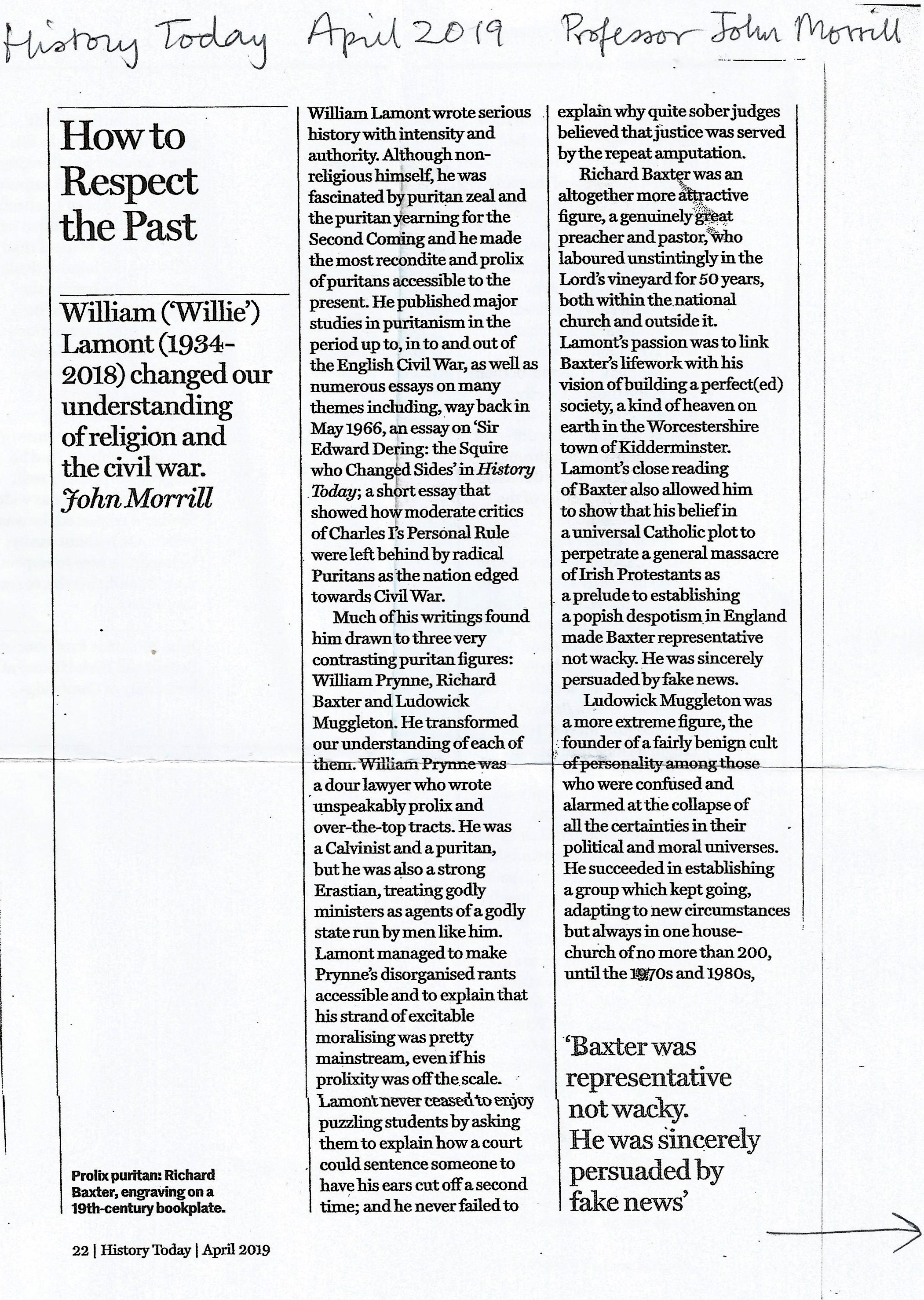
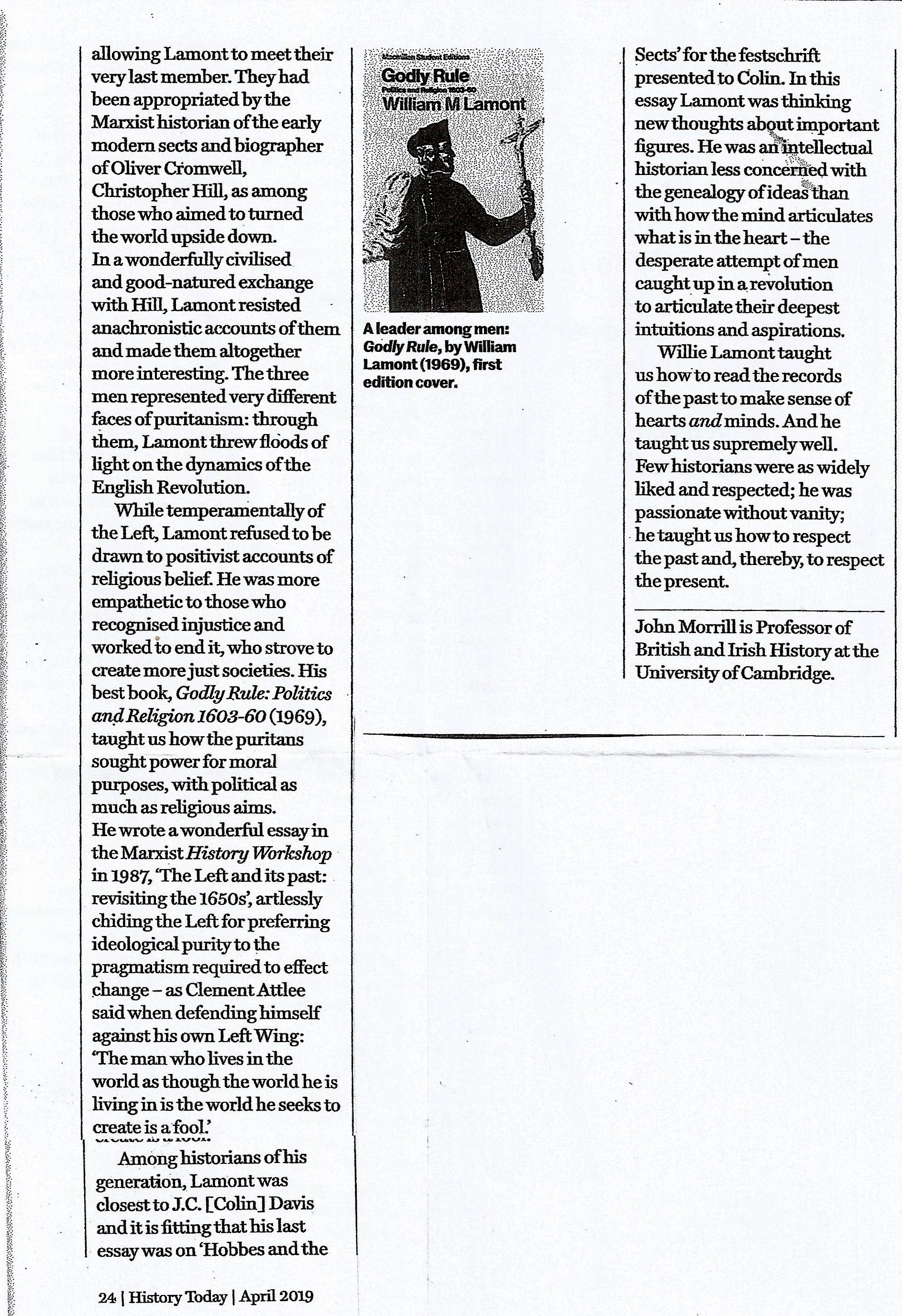
Mark Goldie
William Montgomerie Lamont was born on 2 February 1934, the son of Hughina MacFadyen and Hector Lamont. His father was a London bank clerk, but both parents had recently moved from Scotland. Known in childhood as Billy, and in adulthood as Willie, he was educated at Harrow Weald County Grammar School and Queen Mary College, London University. He knew himself to belong to the fortunate generation of the post-War grammar school and debt-free university educated. Lamont was for a few years a history teacher at St Paul’s School and Hackney Downs School. Simultaneously he undertook doctoral research at the Institute of Historical Research. There he met and married a fellow student, Linda Murphy, later national Director of the Patients’ Association, the NHS pressure group, and a lay magistrate. Lamont was briefly a lecturer at Aberdeen College of Education.
In 1966 he landed his dream job, a lectureship at the new University of Sussex (where the interview panel comprised just the Vice-Chancellor Asa Briggs and the literary scholar Boris Ford). He spent thirty-three years at Sussex, until his retirement, becoming Reader in 1970 and Professor in 1980. He lived first in the village of Kingston on the South Downs, that haven of academics, then in the manor house at Denton, next to Newhaven, a fine venue for Labour Party meetings, and finally in a town house in Lewes. Lamont managed to be immensely productive in research, while devoted to teaching, and sitting on innumerable committees, fearlessly, at Senate and in his School Deanship, resisting the relentless march of managerialism and departmentalisation. He also spent time taking history to the wider community, lecturing for the Historical Association, publishing in History Today, and as President of the Cromwell Association.
He admired the early Sussex model, based upon broad schools of study, rather than disciplinary departments, in which degrees comprised one half a ‘major’ subject and one half ‘contextual’ interdisciplinary subjects. The contextual papers involved co-teaching with colleagues in different fields. His teaching with Sybil Oldfield produced their joint edition of texts, Politics, Religion, and Literature in the Seventeenth Century. Lamont also, in his early years, helped shape the Sussex scheme for teacher training, which involved, not long courses of theory interrupted by brief ordeals in the classroom, but long-term placements in schools under the guidance of a teacher-tutor. His initial appointment was in ‘History and Education’ in the School of Educational Studies, latterly renamed the School of Cultural and Community Studies.
Lamont researched his PhD under the benign but exiguous supervision of the Cambridge scholar Robert Latham (editor of Pepys’s Diary). His topic was the seventeenth-century Puritan lawyer and polemicist William Prynne, who wrote a brazen defence of the Parliamentarian cause during the Civil War, but is chiefly known for having his ears cut off by Charles I as punishment for sedition. Prynne published more wordage than most, an outpouring of argument, invective, and partisan historical and legal scholarship. Later, Lamont wrote a study of another verbose, charismatic, and intransigent Puritan, the great divine Richard Baxter, whose autobiography, Reliquiae Baxterianae, has good claims to be Puritanism in epitome. Yet neither was Lamont’s most widely read book, which was his brief, trenchant, and captivatingGodly Rule: Politics and Religion, 1600-1660 (1969), which surveyed rival claims, in that god-soaked century, to know the divine plan for earthly government. Later, Lamont produced a study of that most outre of religious movements, the tiny sect of Muggletonians, which astonishingly lasted until the twentieth century, and whose archive emerged in Kent in the 1970s.
Lamont was an unbeliever who spent his life studying religious writing and exploring connections between politics and religion during England’s century of revolution. He began a quiet historical revolution, taking the history of ideas seriously, and taking Christian ideologues at their word, not reducing their piety to a symptom of something more ‘real’. Quiet, because he did not produce methodological justifications of this approach. Yet his work was path-breaking, given the dual pall of disdain for ideas, especially religious ones, as irrelevant to power, in the work of Geoffrey Elton and Lewis Namier, and of Marxists. Lamont’s greatest feat of sympathetic re-imagining of past mindsets was his exploration of millenarianism, belief that the present world would soon end and that Christ would reign in glory. He showed that apocalyptic expectation imbued most seventeenth-century Christianity, if it lent only to some a violent urgency about inaugurating the rule of the saints; only later did such belief become ‘a creed for cranks’. Lamont revered his predecessors in this field, the medievalist Marjorie Reeves (Joachim of Fiore), and Norman Cohn (The Pursuit of the Millennium).
Lamont enjoyed historical controversy, crossing swords in academic journals, but hated rancour. His natural homes were Past and Present and History Workshop Journal. Yet he was catholic and non-sectarian, befriending historians as diverse as Edward Thompson, Christopher Hill, Hugh Trevor-Roper, John Pocock, and Patrick Collinson. Although he never went abroad until 1969, he relished a year’s exchange at Stonybrook, directing a seminar series at the Folger Institute in Washington DC, and lecturing on the English Revolution in China in the aftermath of the Cultural Revolution.
Lamont had few graduate students, sending his epigone to places where early modern research was thicker on the ground. But his followers, admirers, and heirs are legion. He had an immense talent for friendship, huge (some thought excessive) patience with colleagues and students, and passions for the Labour movement, storytelling, Arsenal, and writing letters to newspapers. He is survived by Linda, three daughters, Catriona, Ailsa, and Tara, and nine grandchildren. In 2016 Linda published an informal festschrift, Willie Lamont, History Man. Willie died on 31 December 2018.
Beryl Williams, University of Sussex
Historian Professor Willie Lamont, who taught at Sussex from 1966 to his retirement in 1999, died on 31 December 2018.
He came to Sussex after taking his BA and PhD at London’s QMC, and after several years as a school teacher in London, first at St Paul’s School and later at Hackney Downs. He then moved to Aberdeen as Lecturer in History and Education at Aberdeen Training College.
Invited to come to Sussex, Willie taught first in the Education area, with a joint post in History and Education, developing the University’s Bachelor of Education degree and setting up a close relationship with local schools. He also worked tirelessly in the field of adult education.
The role of these so called ‘e-tutors’ ended when the School of Education was founded and Willie then moved full time into the History Subject Group.
His doctorate had been on the 17th-century English Puritan lawyer and statesman William Prynne, and Willie became a leading scholar of the long post-Reformation period of British history, with a wide-ranging expertise in political debates, religious practice, and the significance of locality.
Among his many publications, his work on the Muggletonians led to the presentation to the University of a portrait of the sect’s founder, Lodowicke Muggleton.
Willie’s admiration for radical dissent meant that he always listened to new ideas, and valued ‘grit’ in the system when some people thought that things should change. This carried over into his politics, and he and his wife were staunch supporters of the Labour Party.
His background in the field of education meant that he took school teaching immensely seriously and cared passionately about teaching standards in schools as well as in universities. He also believed in teaching through documents and by emphasising historical arguments. One book he edited was of essays by his Sussex colleagues, called Historical Controversies and Historians (1998).
Willie was heavily involved in many university committees and was Head of History and a warm and sympathetic Dean of the former School of Cultural and Community Studies (CCS).
He was a visiting professor in America and in China, being an early participant in the exchanges between the History Subject Group and Chinese universities.
Although brought up in London, Willie was a proud Scot and returned often to Scotland. His other passions were the cinema, on which he became an expert, and Arsenal Football Club.
An immensely likeable and charming man, he was a great support to many colleagues; indeed he was indispensable to History in Sussex and the Subject Group would not have been the same without him. He will be much missed.
Gaby Weiner, Lewes Labour Party
William (known as Willie) Lamont, who died 31st December aged 84, was an inspiring historian and teacher and long-time member of the Labour Party. Born in Harrow, Middlesex, Willie was the eldest child of a Hebridean, Hector Lamont, and his wife, Hughina (née MacFadyen). Willie attended Priestmead Primary School (interrupted by evacuation to Oban in 1941) and then Harrow Weald Grammar school. After graduating from Queen Mary College, University of London (now Queen Mary University), he combined school teaching with doctoral research on the seventeenth century, and in particularly on the ideas and influence of the Puritans.
An unbeliever himself, he insisted that the Puritan faith, what was said and written, should be taken seriously, however eccentric to modern eyes. His work led to re-evaluations of how Puritans and Puritanism contributed to, the English revolution, the rise of capitalism and the middle class, parliamentary government, the scientific revolution and, eventually, the rise of secular individualism.
After a lectureship in history at the Aberdeen College of Education, in 1966 he was appointed to a lectureship in history and education in the School of Cultural and Community Studies at the new University of Sussex where he was to remain for the rest of his career, becoming a professor in 1980.
In the 1970s and 1980s, Willie helped to pioneer new ways of training history teachers and wrote trenchantly on how history should be taught. Having benefited from educational opportunities his parents never had, he believed passionately in education as a lifelong experience for all. As an historian, his hero was Oliver Cromwell. He memorably gave the annual Cromwell lecture beside the statue of Cromwell at the Houses of Parliament. Freedom of expression and democracy were constant threads in his life and beliefs which led him to support the Labour Party through thick and thin right up to the end of his life.
An enemy of bureaucracy in higher education, he was also an energetic proponent of keeping the doors of higher education open to all-comers. He was a socialist, democrat and all-round good person. He will be hugely missed.
The Old Wealden News and Views, No.43 February 2020 Ed. Linda Jane
Linda Lamont phoned me (Ed.) on February 19th 2019 to tell us about her husband, Willie, who died on New Year’s Eve. As tribute to him she wanted to make us aware of the book ‘Willie Lamont: History Man’ written by and for him before he died. Willie was involved in education throughout his career, was passionately grateful for his own, which was thanks to the 1944 Education Act, and specifically also to the particular ethos of Harrow Weald. When the book was published as a gift to Willie, in 2016, Linda wrote of it:
‘Willie has lived through an era of great educational change during the last eight decades and more. The autobiography through education which he had planned to write was cut off after only three chapters by illness, which he has borne with grace, humour and dignity.
This book fills the gaps in Willie’s story through the contributions of the many historians, friends and students who wanted to describe the impact he has made on their work and lives. They include favourite passages from his books and give a picture of the teachers and schools which inspired him, as well as the University of Sussex where he worked for 33 years.’
Linda has given us permission to use extracts from ‘History Man’ in this tribute to him, but also invites us to read it in full. I have done that, and I strongly recommend you to it. It’s a richly beautiful account of a life enjoyed with passion for his subject, for his family, and for just being alive.
The website where the book may be found is https://willielamont.home.blog/
This is a user-friendly website which is a joy to visit, and Willie’s face smiles out at you straight away. For the book itself, click on the ‘History Man Book’ tab, and then scroll down to click on the small square in the top right of the ‘brick’ picture. It’s easy, and it’s so worth a visit, as I hope the following will show.
William Montgomerie Lamont started at Harrow Weald in 1945. That he came to the school at all was down to the courage of his shy mother, who went to the Education Office and stated that her son needed to go to the co-educational school up at Brookshill, not the ‘boys only’ one down in Harrow to which he had been allocated. She must have shown determination, because the decision was overturned and he started at Harrow Weald. Throughout his life he said how thankful he was for it, because the ethos of Harrow Weald suited him so perfectly.
Going to Harrow Weald was, Linda says, ‘a great educational experience upon which many of Willie’s future ideas on education were to be based.’ Chapter 2 of the book, one of those written by Linda herself, is devoted to the school:
Linda writes:
‘Two small battered exercise books have recently come to light in the family archive: Willie’s first English exercise book starting in September 1945 and his report book for the seven years of his education at Harrow Weald School. As an eleven-year-old, Willie’s English style was already fluent and racy, his spelling good and his handwriting amazingly neat. Correspondents and students who were to struggle with his barely comprehensible scrawl in later years – Tim Cooper describes ‘Willie’s glorious but shambolic handwriting’ – would scarcely credit the difference.
The very readable adventure story written in his first term is headed by a suspiciously elegant drawing of a boat, either a tracing or with help from his artistic father. The evidence is strong for having read books such as Kidnapped and Treasure Island with his mother. The whole family must have been proud when he appeared in print for the first time in his life in the 1946 summer edition of the school magazine The Weald Chronicle, with a three-page story Glenaros Castle.
The report book is considerably more concise. Teachers had only the space of about three postage stamps to convey their opinions of the pupil’s work, which they did with admirable vigour and precision, often in exquisite, tiny handwriting. Between them, they give a clear description of Willie’s school career.
The opening pages give a discouraging account, given twice a year, from his physical education master, beginning with ‘Very slow progress’ and ending with ‘Nothing very creditable.’ Accompanying this were the revealing statistics of his height, weight and chest measurements. These show an eleven-year-old, small for his age, who gradually grew to an average height at eighteen, only achieving his father’s near six foot after he left school.
English was a different matter. It was here that Willie excelled until the sixth form when a new teacher was more critical of his style: ‘He must learn that life is not a recurrence of clichés’ and: ’His occasional failures of taste are disturbing.’ But honing his style was to win him a university exhibition. A-level Latin was a requirement for arts university entrance and Willie developed a crush on one of his Latin teachers. One can see why when she refers to his ’originality seasoned as always with a touch of cheerful daring.’
His maths and science reports show the despair that teachers must feel at a total lack of interest. ‘Geometry very poor because he seems quite incapable of following simple instructions.’ Maths did begin to improve but there was a steady stream of D grades in science. A fellow pupil, John Butcher, recalls the art teacher saying, on being faced with a hopeless blob by Willie: ‘I can’t even give this a D; it deserves an L or an R.’ Happily there is no record here of his disastrous woodwork classes.
It was in history that Willie began to develop an interest which was to shape his academic future. This was largely due to the influence of his sixth form history master, the charismatic Arthur Halfpenny, known as ‘Shove’ to his pupils. Despite early criticism of his ‘love of fine phrases’ and even ‘ornate verbosity’, Willie’s A level work is described by the time he left as ‘keen, lively, intelligent.’ Willie had become a prefect and a house captain. His ‘ready wit’ was appreciated in his role as editor of the school magazine, as well as president of the debating and diagnostic societies. Less understandable in this list of achievements are membership of the dancing club and of the house choir, though joining the drama and tennis clubs were to foster strong future interests.’
Contemporaries of Willie’s at Harrow Weald, John Butcher and Colin Finn, follow Linda’s account, full of school gossip and definitely to be read!
In Willie’s own words, the school had ‘a philosophy inspired, initially, by Barlow Butlin which laid stress on co-operation, not competition; which credited the contribution of all members of the school, not just the cleverest or the most athletic – albeit (as an after-thought almost) we did do rather well in academic and athletic competition.’
Willie’s continued journey through his own education was via Queen Mary College, University of London, for his degree, The Institute of Education for his formal teacher training – where he reportedly learnt how not to train teachers – and The Institute of Historical Research for succour, support and company during his PhD studies, supplemented for income by some teaching at St Paul’s School. Then, in 1959, he applied to teach history at the iconic Hackney Downs School – the ‘Grocer’s’ – and to his enormous surprise was successful. During his four years there, learning how to keep order, inspiring pupils who would never forget him, Willie was granted his doctorate, and became the only member of staff to have the title of ‘Dr’. However, in 1963, after TB had forced him away from the school, and eventually to leave school teaching altogether, he became a teacher at the, very cold, Aberdeen training college, reportedly transforming some of its older rigid practices. Then, in 1966 he moved to the place that would become his academic home for the rest of his working life: Sussex University.
Everywhere he went, Willie made lifelong friends whose memories of him make up a great part of ‘History Man’, and it is the warmth, humour, and kindness they remember, as well as his devoted and passionate scholarship. One quote, among many, gives a glimpse of his legacy, this one from a Hackney Downs pupil, Geoffrey Alderman:
‘Willie and I thus became academic colleagues. But we remained firm friends. Exploiting that friendship, I once plucked up the courage to ask him what it had been like to teach me. ‘It was nerve- wracking,’ he replied, reminding me that it was my invariable custom to have open on the classroom desk the relevant volume of the Oxford History of England, just to make sure that Dr Lamont got his facts right! Which he did, of course. Life is a series of encounters. My encounter with Willie Lamont was life-changing. And for that I shall be eternally grateful.’
The multitude of ‘Sussex’ contributions to ‘History Man’ show just how much he affected the lives of both peers and students, across those years, and with Willie’s own writings too, ‘Sussex’ comprises more than half of ‘History Man’. One anecdote among the many is from colleague John Jacobs:
‘Willie was above all very funny and loved sharing his humour with all around him. On the door of his room in CCS he had pinned a cartoon depicting Jesus preaching on the mountain. At the back of the crowd listening to him were two men, one of whom was saying, ‘He’s a great teacher, but what has he published?’ This at the time when the university was still reeling from the newly imposed Research Assessment Exercise which was supposed to goad everyone into doing much more research and which was not universally welcomed. Typically, he had found it funny and wanted to share it with as many people as possible.
As part of the ‘Sussex’ contributions, colleagues and students have chosen their own favourites among Willie’s work to introduce and present, and so we have wonderful examples of his writing to enjoy. You can pick any page of Willie’s work at random and be instantly enthralled and need to read more, however unfamiliar the subject matter. He is fluent, funny, concise, clear, and of course, ready to back up his lively statements with beautiful scholarship. Willie’s own choices for the work to go in his ‘autobiography through education’, chosen before becoming too ill to continue, are there too, and most brilliantly in Chapter 4, in his account of ‘Hackney Downs School.
Willie died on New Year’s Eve 2018, and Linda said he had been able to recognise and was pleased to see nearly all his nine grandchildren soon before his death. She felt that although it was of course sad, it was welcomed as an end to his suffering, and that it felt somehow an important and significant day to go, at the very end of the year.
One of the testimonials of which I suspect Willie would be most proud is that from his grandson, Luke Hollander, who after declaring to his grandparents that his A level history essays were just ‘box ticking’ and straightforward, was sent a gift by them: ‘The History Debate’, in which his grandfather had written an essay. Luke has chosen it to present in ‘History Man’ as an example of Willie’s work. He writes:
‘I recall….how surprised I was reading Willie’s prose for the first time. (His) ability to weave stories of personal interest around a wider theme made his work both readable and persuasive in a way I had not hitherto been exposed to. His writing…. has taught me to admire the wit and excitement a historian’s prose can achieve, as well as the variety of ways one can approach the subject.
History is not just ticking off facts against a mark scheme, as I understood it through my limited A-level experience. History could be about constructing imaginative, personal arguments to reach a deeper understanding of events and people in the past and the present, whether that was through anecdote, wit or rigorous statistical analysis.’
‘History Man’ is a lovely tribute to an Old Wealden many will remember with great affection, and who had a happy and influential life after those founding years at Harrow Weald. Reading back, though, through those ‘battered exercise books’ described by Linda at the start of this tribute, it’s endearing and comforting to remember that Willie was also pretty average at some things, and abysmal at a few, as well as being clearly outstanding in those that he loved, and an altogether lovely man.
I learnt such a lot reading History Man, about the Muggletons, Millenarians, the academic and social life of the Institute of Historical Research, and indeed, a word new to me, and which Linda says describes his book: the Festschrift. A beautiful word for a collection of writings written in honour of a scholar, and presented as a gift during their lifetime. For those who love Latin too, it becomes a ‘liber amicorum’. So lovely to do this and to let a person see how others value their life’s achievements, while they live.
Willie was Scottish, of course, and Linda describes in the book his life before Harrow, and that of his Scottish family, still based on Lismore, the island you will know if you have ever been on a CalMac ferry from Oban to Mull. Willie’s mother lived there before marriage, and the new family then moved to Oban. Willie’s father was a purser with Caledonian MacBride ferries There are wonderful photos accessible on the website by just moving your mouse below the ‘History Man’ book tab.
Glenaros, the inspiration for his first published work, in the Weald Chronicle, is of course on Mull, and it isn’t surprising that his mother introduced him to Kidnapped, because R L Stevenson set it in the most adventurous of places familiar to him, a tidal island, Erraid, at the tip of the Ross of Mull, between Mull and Iona, rugged and remote, about one mile square, infinitely full of romance and adventure. Willie must have loved it.
The Argus Newspaper
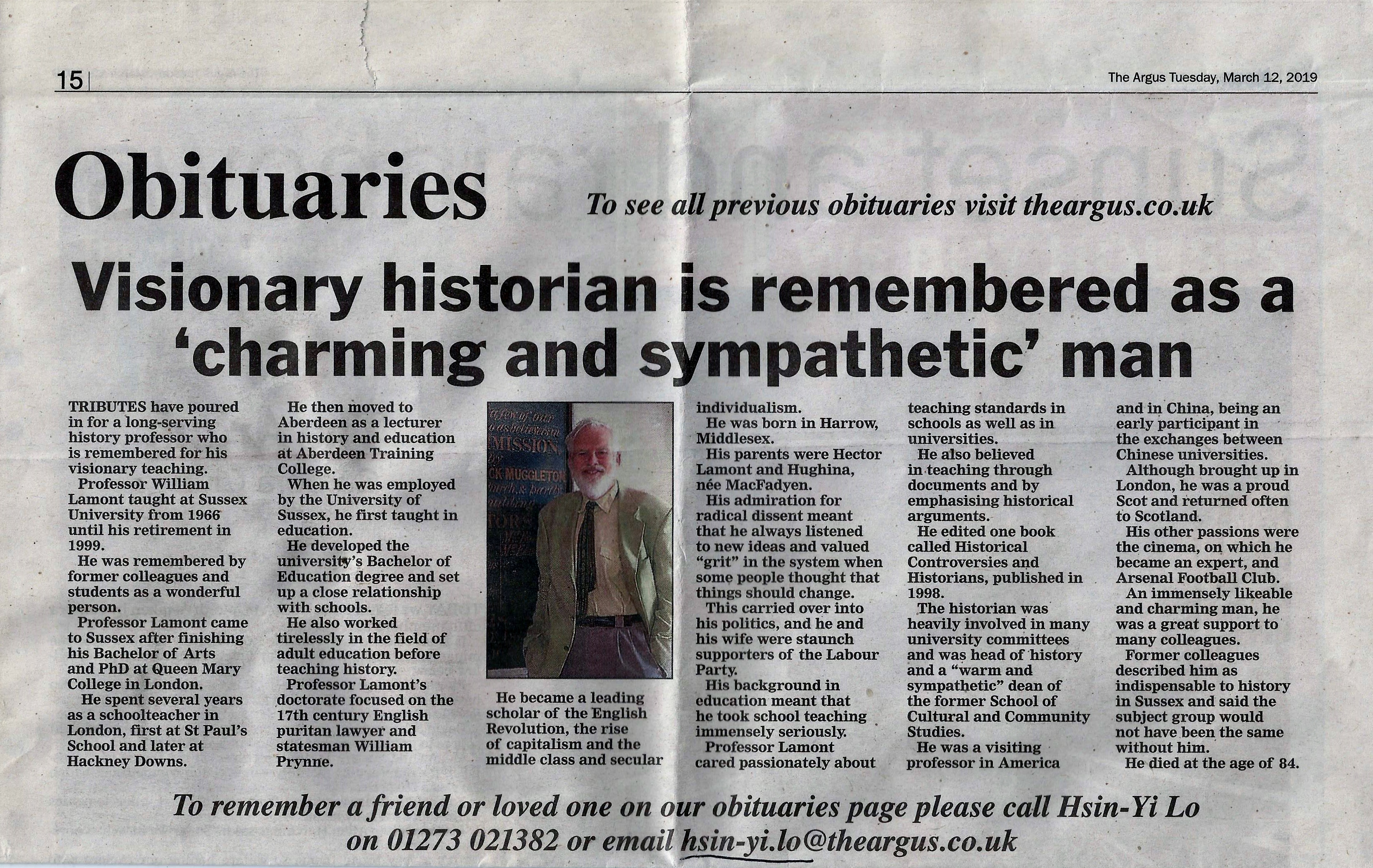
TRIBUTES have poured in for a long-serving history professor who is remembered for his visionary teaching.
Professor William Lamont taught at Sussex University from 1966 until his retirement in 1999. He was remembered by former colleagues and students as a wonderful person. Professor Lamont came to Sussex after finishing his Bachelor of Arts and PhD at Queen Mary College in London. He spent several years as a schoolteacher in London, first at St Paul’s School and later at Hackney Downs. He then moved to Aberdeen as a lecturer in history and education at Aberdeen Training College. When he was employed by the University of Sussex, he first taught in education. He developed the university’s Bachelor of Education degree and set up a close relationship with schools. He also worked tirelessly in the field of adult education before teaching history. Professor Lamont’s doctorate focused on the 17th century English puritan lawyer and statesman William Prynne. He became a leading scholar of the English Revolution, the rise of capitalism and the middle class and secular individualism. He was born in Harrow, Middlesex. His parents were Hector Lamont and Hughina, née MacFadyen. His admiration for radical dissent meant that he always listened to new ideas and valued “grit” in the system when some people thought that things should change. This carried over into his politics, and he and his wife were staunch supporters of the Labour Party. His background in education meant that he took school teaching immensely seriously. Professor Lamont cared passionately about teaching standards in schools as well as in universities. He also believed in teaching through documents and by emphasising historical arguments. He edited one book called Historical Controversies and Historians, published in 1998. The historian was heavily involved in many university committees and was head of history and a “warm and sympathetic” dean of the former School of Cultural and Community Studies. He was a visiting professor in America and in China, being an early participant in the exchanges between Chinese universities. Although brought up in London, he was a proud Scot and returned often to Scotland. His other passions were the cinema, on which he became an expert, and Arsenal Football Club. An immensely likeable and charming man, he was a great support to many colleagues. Former colleagues described him as indispensable to history in Sussex and said the subject group would not have been the same without him. He died at the age of 84.
Other Academic Tributes
Some academic tributes to Willie Lamont sent to Mark Goldie, January 2019
Professor Tim Harris, Brown University:
I’m terribly sorry to hear about the death of William Lamont. I didn’t know him well, though had met him a couple of times and had some impression of what a lovely man and an inspirational teacher he must have been. I know you were close to him. The website looks like a lovely tribute to the man and his career. Very sad – and sorry to hear this.
Professor John Coffey, Leicester University:
I’m very sorry to hear the news about Willie. He was a great help and inspiration to me and it is a pleasure to hear his voice again on the website interviews and to read more about his career in the festschrift. Many thanks for passing this on.
Professor Neil Keeble, Stirling University:
I am very sorry to learn the news of Willie’s death. Our Baxterian paths of course often crossed and, though we saw things rather differently, I found him always generous and wonderfully encouraging. In the early ’80s I organized a Bunyan conference at Stirling and I still remember with great affection the wonderful prospect of Willie’s enthusiastic Highland dancing at the conference ceilidh!
Professor Alexandra Walsham, Cambridge University:
How very sad. Thank you very much for passing on this news.
Dr Kate Peters, Cambridge University:
Thanks for letting me know about this. Very sad, and a lovely man.
Dr Gabriel Glickman, Cambridge University:
Thanks very much for passing this news on. My memory of two meetings with him is that he was as warm and generous as he was distinguished. Very useful to have the link to the bibliography: quite a few important-looking works there with which I was unfamiliar.
Professor Quentin Skinner, Queen Mary London:
I hadn’t heard about Willie Lamont’s death, so I was extremely grateful to you for sending me the very touching website. He must surely have been an important figure to you when you were at Sussex, and although I didn’t know him well myself I always found him enchanting as well as learned company.
Professor Michael Hunter, Birkbeck London:
Thank you so much for passing on this sad news, which I had not otherwise heard. Willie was a lovely man, and it is a lovely tribute.
Dr David Wykes, Dr Williams’s Library London:
Willie did stand out, not only because of his scholarship and contribution to the subject, but because he was such a tremendous person: his generosity of spirit, kindness, and enthusiasm. I was less aware of his enthusiasm for Arsenal Football Club until I went to visit him in his care home, but it was typical.
Dr Brian Young, Oxford University:
I was saddened to hear of the death of Willie Lamont, a splendid and generous Sussex colleague. They don’t make them like that anymore, sadly.
Dr Grant Tapsell, Oxford University:
This is very sad news. The website is an attractive tribute – not least the photo gallery. Your bibliography is also a reminder of just how much, how widely, and how well he published.
 William Montgomerie Lamont (1934-2018)
Delighted and saddened to realise he’s a distant cousin: my great-great-grandmother and his great-grandfather were siblings.
Sad because I wish I’d known when he was still around! He was a contemporary of my Dad, who died in 2017.
LikeLike